
Mastoiditis Treatment in Mumbai
Mastoiditis
A swelling behind the ear, an ear appearing pushed forward, persistent pain after a course of antibiotics, or fever that will not settle following an ear infection are warning signs that infection may have spread beyond the middle ear into the mastoid bone.
If you are searching for mastoiditis treatment in Mumbai, it means the situation has moved beyond a routine ear infection — and timely specialist evaluation is now not just important but urgent. Mastoiditis can progress rapidly, and the window for effective non-surgical treatment narrows quickly once the infection establishes itself within the mastoid bone.
Although mastoiditis has become less common since the widespread use of antibiotics, it remains one of the most important and serious complications of middle ear infection in India. Studies report that acute mastoiditis develops in approximately 1 in 400 cases of acute otitis media, with the paediatric incidence estimated at around 4 cases per 100,000 children per year in countries with good antibiotic access — and likely higher in settings where ear infections are undertreated or incompletely treated. In India, where recurrent ear infections are common and antibiotic courses are sometimes incomplete, the need for an experienced mastoidectomy surgeon in Mumbai remains significant and should not be underestimated.
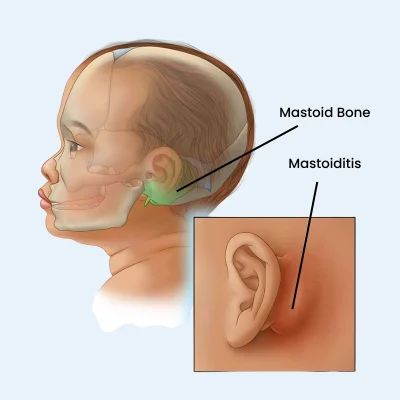
What Is Mastoiditis?
The mastoid bone is the prominent bony prominence felt just behind the ear. It is not a solid bone — it is filled with interconnected air-filled cells, similar to a honeycomb, that are directly connected to the middle ear space. This anatomical connection means that infection from the middle ear can spread freely into the mastoid air cells, causing inflammation and — if untreated — destruction of the bony partitions between those cells.
Mastoiditis is the infection and inflammation of the mastoid bone and its air cell system. It most commonly develops as a complication of acute otitis media — middle ear infection — when bacteria spread from the middle ear into the mastoid. It can also develop in the context of chronic ear disease, particularly when a cholesteatoma is present and has eroded into the mastoid. Early recognition and prompt mastoiditis treatment Mumbai are essential to prevent serious and potentially life-threatening complications.
Types of Mastoiditis
Acute Mastoiditis
The most common form, developing rapidly — usually within days to weeks — as a direct extension of acute middle ear infection. The mastoid air cells become filled with pus, the bony partitions between cells begin to break down, and a subperiosteal abscess — a collection of pus beneath the periosteum covering the mastoid bone — may develop, causing the visible swelling and redness behind the ear that brings most patients to emergency ENT care.
Masked Mastoiditis
A more subtle and diagnostically challenging form in which mastoid infection develops slowly — often in a patient who has been taking antibiotics that suppress but do not eliminate the infection. Symptoms are less dramatic than acute mastoiditis, but the underlying disease continues to progress. Patients may have persistent ear discharge, mild ear pain, and a low-grade fever without the obvious swelling behind the ear seen in acute cases. A high index of suspicion and CT imaging are essential for diagnosis.
Chronic Mastoiditis
Develops in the context of chronic ear disease — most commonly when chronic suppurative otitis media or a cholesteatoma has been present for an extended period. The mastoid bone is progressively eroded over months to years, and the presentation is usually with chronic ear discharge, hearing loss, and imaging findings of mastoid destruction rather than the acute pain and swelling of acute mastoiditis. Chronic mastoiditis almost always requires mastoid surgery Mumbai as the definitive treatment.
Why Mastoiditis Is Dangerous — Complications If Untreated
The mastoid bone sits in close proximity to several critically important structures — the facial nerve, the inner ear, the major venous channels draining the brain, and the brain itself. As mastoid infection progresses and bone is eroded, infection can spread to any of these neighbouring structures, causing complications that are serious, some of which are life-threatening:
- Subperiosteal abscess – pus collects beneath the skin behind the ear, causing visible swelling and pushing the ear forward; this is the most common complication and the one that most often prompts emergency presentation
- Bezold’s abscess – pus tracks down through the mastoid tip into the neck, causing a deep neck abscess that requires urgent surgical drainage
- Facial nerve paralysis – erosion of the bony canal surrounding the facial nerve causes weakness or complete paralysis of one side of the face
- Labyrinthitis – spread of infection into the inner ear causes severe vertigo, nausea, and sensorineural hearing loss
- Sigmoid sinus thrombosis – infection spreads to the major venous channel near the mastoid, causing blood clot formation with risk of septic emboli
- Meningitis – bacterial infection reaches the lining of the brain, causing headache, neck stiffness, fever, and photophobia
- Extradural or brain abscess – pus collects between the brain and its surrounding bone, or within the brain substance itself a neurosurgical emergency
These complications are uncommon when mastoiditis is identified and treated promptly, but they become increasingly likely with every day of delay. This is why mastoiditis treatment Mumbai should be sought urgently — not after waiting to see whether things improve on their own.
Symptoms That Require Immediate Attention
Seek urgent ENT evaluation if any of the following are present:
- Swelling or redness behind the ear – particularly if the skin feels warm and the swelling is growing
- The ear appearing pushed forward or outward – a classic sign of subperiosteal abscess formation
- Ear pain that is worsening despite antibiotics – or pain that returns after initial improvement
- Persistent fever – especially if it has not settled within 48 hours of starting antibiotics for an ear infection
- Ear discharge that is increasing – or discharge that has become thick, foul-smelling, or persistent
- Hearing reduction – new or worsening hearing loss in the context of an ear infection
- Headache, neck stiffness, or sensitivity to light – warning signs of possible intracranial spread requiring emergency assessment
- Facial weakness – drooping of one side of the face, difficulty closing one eye, or asymmetry of the smile
- Severe dizziness or vertigo – suggesting possible inner ear involvement
Children are particularly vulnerable because they cannot always describe their symptoms clearly. Parents who notice unusual swelling behind the ear, a child pulling at the ear and crying more than expected, or general deterioration after an ear infection should seek same-day ENT evaluation without waiting for the next routine appointment.
How Mastoiditis Is Diagnosed?
Clinical Examination
The ENT specialist examines the ear under a microscope or with an otoscope to assess the eardrum, identify any perforation or discharge, and look for signs of middle ear infection. The area behind the ear is examined for tenderness, swelling, and skin changes. The position of the ear relative to the head is noted — forward displacement of the ear is a significant clinical sign of subperiosteal abscess.
High-Resolution CT Scan of the Temporal Bone
CT scanning is the most important investigation in suspected mastoiditis. It confirms the diagnosis by showing clouding of the mastoid air cells, breakdown of the bony cell walls, the presence and extent of any abscess collection, erosion of the bone surrounding the facial nerve canal or tegmen, and any intracranial extension. The CT scan directly guides both the medical and surgical management plan and is essential for an experienced mastoidectomy surgeon Mumbai to plan the operative approach precisely.
Blood Tests
A full blood count showing elevated white cell count, raised C-reactive protein (CRP), and elevated erythrocyte sedimentation rate (ESR) confirms active infection and systemic inflammation. Blood cultures are taken in febrile patients before antibiotics are started, to identify any bacteraemia and guide antibiotic selection. Serial blood tests during treatment monitor the response to antibiotics and help in deciding whether escalation to surgery is required.
Microbiological Swab
A swab of any ear discharge is sent for bacterial culture and antibiotic sensitivity testing. The most common causative organisms include Streptococcus pneumoniae, Streptococcus pyogenes, Staphylococcus aureus, and Pseudomonas aeruginosa — each with different antibiotic sensitivities. Culture results guide the choice of the most effective antibiotic and identify any resistant organisms.
Medical Treatment — Intravenous Antibiotics
Early mastoiditis — where the mastoid air cells are involved but the bony partitions are intact and no abscess has formed — can often be treated successfully with aggressive antibiotic therapy. This almost always requires hospital admission and intravenous antibiotics, as oral antibiotics do not achieve the tissue concentrations needed to penetrate inflamed and poorly vascularised bone.
Medical treatment for mastoiditis typically involves:
- Hospital admission – for close monitoring of symptom progression and response to treatment
- Intravenous broad-spectrum antibiotics – started immediately and adjusted once culture and sensitivity results are available
- Transition to oral antibiotics – once clinical improvement is clearly established and the patient is able to tolerate oral medication
- Pain and fever management – with appropriate analgesics and antipyretics
- Regular clinical reassessment – monitoring the size of any swelling, the patient’s temperature, and ear discharge at least twice daily during the acute phase
- Repeat imaging – if there is any deterioration or failure to improve within 24 to 48 hours of starting IV antibiotics
The decision to proceed to surgery is made when the patient is not improving on IV antibiotics, when an abscess has formed, when complications are present or developing, or when the CT scan shows significant bone destruction. In these situations, medical treatment alone is insufficient and mastoid surgery Mumbai becomes necessary without further delay.
Drainage Procedures — Myringotomy and Grommet Insertion
When pus or infected fluid is trapped behind the eardrum, drainage of the middle ear is an important adjunct to antibiotic treatment. Myringotomy a small controlled incision in the eardrum allows infected fluid to drain, relieves pressure, and provides material for bacterial culture. This can dramatically accelerate the response to antibiotics by reducing the bacterial load within the middle ear.
A ventilation tube commonly called a grommet may be placed at the time of myringotomy to maintain drainage, prevent fluid re-accumulation, and allow ongoing irrigation of the middle ear space. In some cases of early mastoiditis, myringotomy with grommet insertion combined with intravenous antibiotics is sufficient to resolve the infection without proceeding to mastoidectomy. The decision is made based on the CT findings, the clinical response, and the surgeon’s assessment of the extent of mastoid involvement.
Mastoidectomy Surgery Mumbai — When and How It Is Performed
When mastoiditis has progressed beyond what antibiotics and drainage can resolve — when a subperiosteal abscess is present, when bone destruction is identified on CT, when complications are developing, or when there is no clinical improvement despite 24 to 48 hours of IV antibiotics — mastoidectomy is required. Choosing an experienced mastoidectomy surgeon is the most important decision at this stage.
Cortical Mastoidectomy
The standard surgical procedure for acute mastoiditis is cortical mastoidectomy — also known as simple mastoidectomy. The surgeon makes an incision behind the ear and removes the infected mastoid air cells, clearing all pus and diseased tissue from within the mastoid bone while preserving the posterior wall of the ear canal and the structures of the middle ear. The procedure creates a cavity that drains freely into the middle ear and is left to heal. Cortical mastoidectomy is highly effective for acute mastoiditis and prevents further spread of infection to surrounding structures.
Drainage of Subperiosteal Abscess
When a subperiosteal abscess is present — the visible swelling behind the ear — it is drained at the same time as mastoidectomy. The abscess cavity is opened, all pus is evacuated, and the wound is irrigated thoroughly. In selected cases of very early, small subperiosteal abscess in a child who is otherwise well and responding to IV antibiotics, needle aspiration of the abscess may be attempted as an initial measure before committing to full mastoidectomy — though formal surgery is required if aspiration does not produce rapid improvement.
Modified Radical Mastoidectomy
When mastoiditis has developed in the context of chronic ear disease — particularly cholesteatoma — a more extensive procedure is required. Modified radical mastoidectomy removes not only the infected mastoid air cells but also the disease within the middle ear, creating a single open cavity that can be monitored and cleaned at follow-up. This procedure is more complex and requires particular surgical expertise in temporal bone anatomy. An experienced mastoidectomy surgeon Mumbai will select the most appropriate technique based on the CT findings, the extent of disease, and whether any complications are present.
Management of Complications During Surgery
When facial nerve involvement, intracranial extension, or sigmoid sinus thrombosis is identified pre-operatively or discovered during surgery, additional surgical steps are taken to address these complications. Management of intracranial complications may require collaboration with a neurosurgeon. This is why mastoid surgery Mumbai for complicated mastoiditis must be performed in a hospital with full neurosurgical and intensive care support — not in a standalone facility.
Recovery After Mastoidectomy
Recovery after mastoidectomy for acute mastoiditis is generally well tolerated:
- Hospital stay of two to five days is typical, during which IV antibiotics are continued and the wound is monitored
- The post-operative dressing behind the ear is changed within the first 24 to 48 hours
- Oral antibiotics are continued for a further two to four weeks after discharge
- Ear drops may be prescribed to maintain a clean ear canal during healing
- Most patients return to normal daily activities within two to three weeks
- Strenuous activity, swimming, and water entry into the ear are restricted for four to six weeks
- Follow-up visits with the surgeon are essential to monitor healing, check hearing, and ensure that no residual infection remains
Hearing outcomes after mastoidectomy for acute mastoiditis are generally good, particularly when the ossicular chain has not been damaged by the infection. In cases where hearing bones have been affected, ossicular reconstruction may be considered at a later stage once the ear has fully healed and is free of infection.
Expert Mastoiditis Care with Dr. Shama S Kovale
Dr. Shama S Kovale — Best ENT Specialist in Mumbai is a highly experienced ENT surgeon with over 23 years of clinical and surgical expertise. She holds MBBS, DLO, and MS in ENT from B.Y.L. Nair Hospital, Mumbai, and has advanced training in Voice and Swallowing Disorders from UC Davis, California, along with a Laryngology Fellowship from Bombay Hospital and Cochlear Implant Training from P.D. Hinduja Hospital.
Currently practicing at Kokilaben Dhirubhai Ambani Hospital Dr. Shama S Kovale brings extensive surgical expertise in ear disease, including cortical mastoidectomy, modified radical mastoidectomy, and the management of complicated mastoiditis. Patients and families across Mumbai searching for urgent mastoiditis treatment Mumbai, an experienced mastoidectomy surgeon Mumbai, or a trusted specialist for mastoid surgery Mumbai consistently choose Dr. Shama S Kovale for her precise diagnostic assessment, calm and clear communication in urgent clinical situations, and proven surgical outcomes in even the most complex ear cases.
FAQs
Is mastoiditis a medical emergency?
Yes — swelling behind the ear, fever, or ear pain not improving with antibiotics requires same-day ENT evaluation. If symptoms are worsening rapidly, go directly to a hospital emergency department.
Can mastoiditis be treated with antibiotics alone, without surgery?
Early cases without abscess or bone destruction can respond to IV antibiotics and middle ear drainage. Once an abscess has formed or there is no improvement within 24 to 48 hours, mastoidectomy surgeon Mumbai consultation is required.
Will my child's hearing be affected after mastoiditis treatment?
When treated promptly before significant bone destruction occurs, hearing is usually well preserved. If ossicles are damaged, hearing reconstruction can be considered six to twelve months after full recovery.
How long does recovery from mastoidectomy take?
Most patients are discharged within two to five days and return to normal activities within two to three weeks. Swimming and water entry are restricted until the surgeon confirms complete healing.
Can mastoiditis come back after surgery?
Recurrence after cortical mastoidectomy is uncommon when surgery is thorough and antibiotics are completed. Patients with underlying chronic ear disease require long-term ENT follow-up to detect any early recurrence.
Closing Swelling behind the ear, an ear pushed forward, persistent fever, or worsening pain after an ear infection are signs that require urgent ENT evaluation — the same day, not the next available appointment. Consulting Dr. Shama S Kovale at Voice of ENT ensures expert mastoiditis treatment Mumbai with prompt diagnosis, precise surgery when needed, and full patient-focused care.
Contact Details
For consultation with Dr. Shama S Kovale at Voice of ENT, visit Kokilaben Dhirubhai Ambani Hospital and Medical Research Institute, Rao Saheb Achutrao Patwardhan Marg, Four Bungalows, Andheri West, Mumbai, Maharashtra 400053.
Call: +91-91528 50769
Email: drshamakovaleent@gmail.com